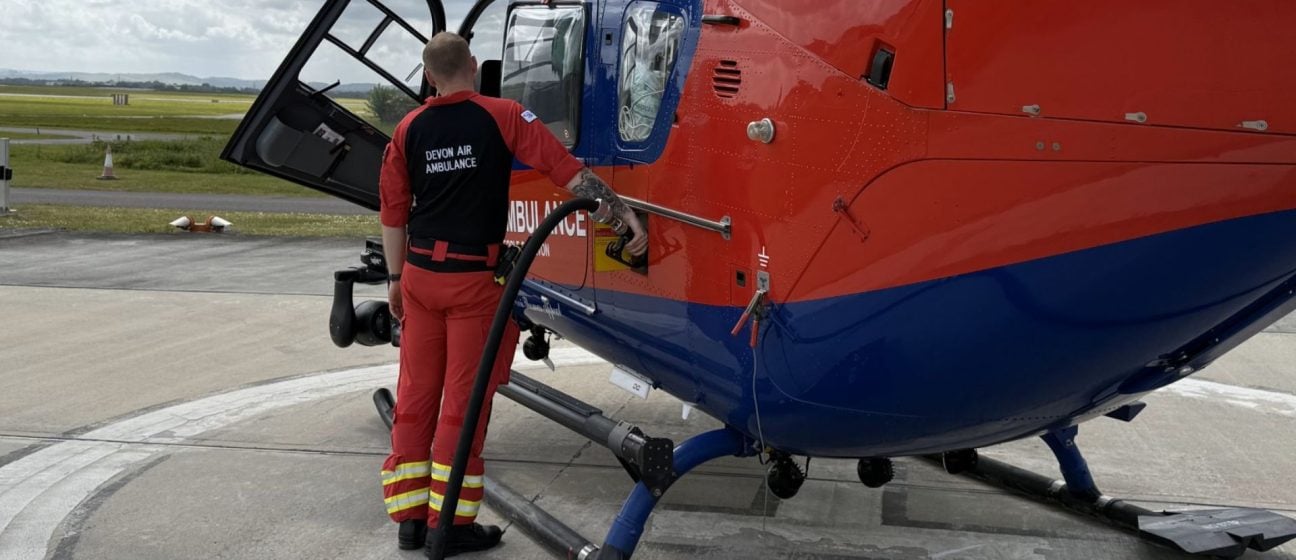
Operational and fuel costs only go up, but thanks to your support so do we. Read more about our two aircraft.
With the cost of fuel and operational costs soaring, we thought you’d like to learn more about the two aircraft that help us respond every day of the year.
Devon Air Ambulance brings expert critical care to people across Devon, reaching patients quickly with highly-trained crews and lifesaving aircraft, so we’ve asked our pilots to answer some of your most frequently asked questions.
How fast are the helicopters?
Both our Airbus EC135 and H145 helicopters cruise at around 140 mph in a straight line, enabling our crew to reach patients quickly across Devon in around 20 minutes. Their speed ensures specialist care arrives fast, even in remote areas, helping us to deliver time‑critical treatment when every second makes a difference.
How big are the aircraft?
Our two helicopters offer compact but highly efficient medical environments. The H145 provides increased cabin space and improved access to patients, while the EC135 offers a smaller, agile airframe ideal for rapid response. Exact dimensions vary by model and can be provided by our pilots, but the largest dimension for both aircraft, from the tip of the rotor blade to the tip of the tail is close to 12m on the EC135, and not far off 14m on the H145.
How heavy are the aircraft?
Each helicopter has a defined maximum take‑off weight set by the manufacturer. The EC135 has a maximum all-up mass of 2,950kg, while the newer H145 benefits from a higher Maximum All Up mass of 3,700kg, which allows for more fuel and equipment to be carried.
How far can the helicopters fly?
Our aircraft operate within Devon and surrounding counties, with flight duration shaped by fuel capacity, conditions, and mission needs. The EC135 has a range of 200 miles, and the H145 extends this to 250 miles when fuelled at base, reflecting operational fuelling rather than full tanks, as carrying more fuel reduces capacity for equipment, medical staff, and the patient.
Who flies the aircraft?
Each mission is crewed by one pilot and up to three clinical specialists, including paramedics and doctors. The aircraft can transport one patient on a stretcher with room for essential equipment. Onboard roles vary depending on the clinical needs of each mission.
Can you fly in bad weather?
Our advanced avionics and training allow us to fly in very poor weather and make instrument approaches back to Exeter airfield similar to an airliner. For conducting HEMS missions we have strict limits for cloud base and visibility to ensure a safe operation.
Aircraft facts
- The H145 gear box is designed by Kawasaki of motorbike fame.
- Over 50% of Air Ambulance operators around the world use Airbus helicopters.
- The H145 family of helicopters have flown over 8.5 million hours globally.
- The enclosed tail rotor design on the EC135 and H145 is called a Fenestron.
Keeping our aircraft fuelled and safe to fly is only possible thanks to your continued support. Though our lifesaving aircraft are not cheap to run, without them we wouldn’t be able to reach the remote locations that we do so quickly to be at the side of our patients.