Dr Lauren Weekes shares what the festive season means for our missions and crew.
Our dedicated crews remain ready to respond, ensuring patients get the care they need every day of the year. Critical Care Doctore, Lauren Weekes, shares an account of a typical festive period.
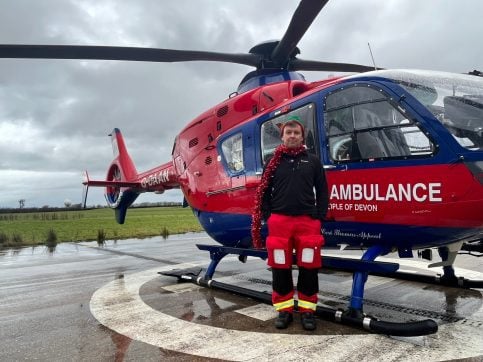
‘The festive period is a busy time for us. In 2024 we were dispatched 174 times, treating 156 patients between 23rd December and 1st January. We don’t change our shift patterns just because of the festivities, our service is identical 365 days of the year. We have two paramedics and a pilot based at our north Devon base, (Eaglescott airfield) and two shifts running from our Exeter base on the north side of Exeter airport.’
What happens on a Christmas shift?
‘The day will begin the same as any other. Our focus when we arrive, usually around 6.45am at Exeter, is to get the aircraft and medical equipment ready for deployment. We have an aviation brief with the pilot; weather is really important to us as there are some conditions that we cannot fly in. For these occasions, we have our Volvo XC90 critical care cars as backup.
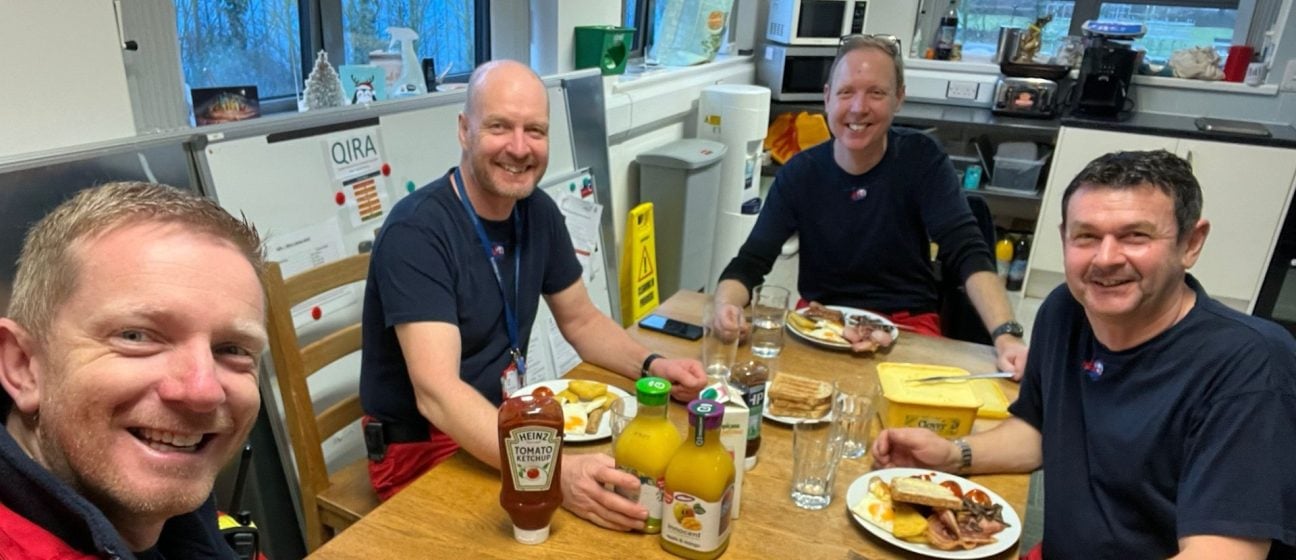
‘Then it’s time for breakfast! It’s really nice to be able to cook and eat together as a crew. We’ll usually divvy up the shopping beforehand, and make sure there’s enough coffee and milk on the airbase; we can’t leave the base at all once we’re on shift, so running out of milk is a big problem. Most emergency services workers are coffee-dependent, and we are no different! (check out our Crew’s Brew from Owen’s coffee) Sometimes the red phone will ring during cooking; both of our airbases have an single big red button which will cut off the appliances so we don’t burn the base down when we’re out; I didn’t know this when I left a batch of croissants in the oven once…luckily it was a weekday and one of our operations managers saved the day!’
Winter incidents
‘Looking at our December incidents since 2019 (when we became clinically independent from the Ambulance service, and were granted our own registration with the Care Quality Commission), we have attended 576 patients. The commonest calls are for patients with medical problems, which account for just over half our calls; followed by accidental injuries and road traffic collisions (both slightly less than one in five). Our sport/leisure-related (horse riding, cycling etc) injuries makes up 3% of the total, which interestingly enough is the same proportion as in July; clearly a hardy bunch in Devon, out in any season.
Sadly, 35% of the calls we attend in December are for patients who have suffered a cardiac arrest. This is always an emotionally challenging type of incident to attend, but somehow it seems more poignant at Christmas.
‘When the crew attend a difficult incident like this, they will usually have a moment with the other emergency services on scene (a debrief) to check that everyone is OK . They’ll also be checked on by the specialist HEMS dispatchers who work in the Emergency Operations Centre, and if needed, by their line manager too. The best support is often from your crew mates though; they understand best how to support you in tricky times.’
White Christmas?
‘The jury’s out on the long-range forecast. We’re pretty unlikely to get a white Christmas in Devon – it’s too mild. Rest assured we can still fly when there’s snow on the ground, although we have to be extra careful when landing and taking off to avoid a ‘whiteout’ when loose snow comes billowing up and blocks view of the landing site.
‘More commonly, murky winter weather means we have to be constantly vigilant for changing conditions, especially reductions in visibility. Our pilots are all trained to undertake instrument landings, but they can only do this to return to the airport, not to reach our patients at scene.’
How you can help this Christmas
- Get your flu jab, and order repeat prescriptions early.
- Stock up on basic medicines and know your address if you’re away from home.
- Download the What3Words app for emergencies in rural areas. The app provides a precise location accurate to 3 metres which you can provide to the emergency services. The app can save vitally important minutes looking for you if you’re in a rural area; it’s surprisingly hard to spot the right people from 500ft up in our aircraft!
- Never drink and drive – protect yourself and others.
Want to support our patients? See our Christmas Comfort Shopping List to help keep patients warm this winter.
Pictured at the top of this page: Crew members enjoying a festive breakfast ahead of their shift.